End-to-end autonomous driving via behavioral cloning — a PyTorch PilotNet CNN predicts real-time steering angles from raw camera frames inside the Udacity simulator, augmented with a rich 8-technique pipeline for robust generalization.
The cornerstone of this project. A diverse 8-technique stochastic pipeline applied at train time dramatically improves model robustness across unseen lighting, shadows, camera angles, and road geometry — the key difference between a model that memorizes and one that drives.
Raw simulator data is heavily biased toward driving straight. Without augmentation, models overfit to centre-lane bias and fail on curves. Our pipeline synthesizes diverse driving conditions — variable brightness, artificial shadows, random panning and flipping — forcing the network to learn generalizable visual features rather than texture shortcuts.
Mirrors the image left-right and negates the steering label. This single technique doubles the effective dataset size and eliminates directional bias — critical because most tracks curve more in one direction than the other.
Translates the image horizontally and vertically by up to 10% using an affine warp. The steering label is adjusted proportionally (+= tx × 0.4), teaching the model to correct for off-center lane positions — simulating lane-departure recovery.
Scales the image by a random factor between 1.0× and 1.3×, then center-crops back to the original size. Simulates varying camera focal lengths and distances from road features, preventing the model from relying on absolute scale cues.
Multiplies the HSV Value channel by a random factor in [0.2, 1.2]. Mimics dawn, dusk, tunnel entries, and overcast skies. Ensures the model responds to road structure, not illumination artifacts.
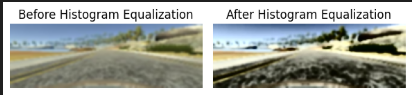
Applies cv2.convertScaleAbs(α, β) with random contrast scale and brightness offset. Complements brightness augmentation to produce a fuller photometric distortion space, preventing overfitting to simulator-specific rendering.
Generates a random polygon mask covering part of the image and darkens it by 50%. Realistically simulates tree shadows, bridge overhangs, and building shadows — one of the most common failure modes for un-augmented driving models.
Runs Canny edge detection (50–150 thresholds) on a grayscale copy, converts to RGB, then blends 0.8×original + 0.2×edges. Reinforces lane-line and road-boundary features that carry the most steering signal.
Adds pixel-level Gaussian noise (μ=0, σ=10) to simulate real camera sensor noise, JPEG compression artifacts, and motion blur. Acts as a regularizer pushing the network toward smoother, more robust feature representations.
random_augment(). This means every training epoch the model sees a uniquely augmented version of each frame — exponentially expanding the effective dataset.
Each frame goes through a deterministic 5-stage pipeline before being fed to the network — both during training and real-time inference.
Slices rows img[60:135, :, :] — removes uninformative sky pixels above and the car's dashboard below. Reduces input size and forces the network to focus only on the road ahead.
Converts RGB to YUV using cv2.COLOR_RGB2YUV. Chosen because YUV separates luminance (Y) — which contains edge and road structure — from chrominance, matching NVIDIA's original PilotNet approach for superior driving feature extraction.
GaussianBlur(3×3, σ=0) softens high-frequency simulator rendering artifacts before the network sees them. Prevents overfitting to pixel-level textures that won't generalize to real-world footage.
Downsamples to the exact NVIDIA PilotNet input dimensions cv2.resize(img, (200, 66)). Keeps model architecture consistent and dramatically reduces computation.
img / 127.5 − 1.0 maps pixel values from [0,255] to [−1,1]. Ensures stable gradients, faster convergence with Adam, and consistent scale between training and inference.
End-to-end CNN based on NVIDIA's 2016 PilotNet. Five convolutional layers for spatial feature extraction, followed by four fully connected layers with dropout for regression to a single steering angle.
ELU (Exponential Linear Unit) avoids the dying-neuron problem of ReLU. Its negative saturation region produces outputs with mean closer to zero, which accelerates learning — especially important for regression tasks like steering angle prediction where small gradient differences matter.
Applied on the first two fully connected layers to prevent co-adaptation of neurons. Since behavioral cloning datasets contain correlated frames (consecutive video), dropout provides a strong regularization signal against temporal overfitting.
Stable training via gradient clipping, adaptive LR scheduling, and best-model checkpointing.
The training set is heavily concentrated around 0° (straight driving), typical of simulator datasets. The augmentation pipeline — especially flip and pan — redistributes the distribution to include more turning angles, addressing the center-bias problem.
Comparing our implementation against key papers in behavioral cloning for autonomous driving. Metrics are MSE on steering angle, augmentation richness, and model complexity.
| Paper / System | Val MSE ↓ | Augmentation | Params | Input | Simulator |
|---|---|---|---|---|---|
|
⭐ Our Implementation
2025 · PilotNet + Rich Aug
|
~0.012 | 8 Techniques | ~252K | 66×200 YUV | Udacity |
|
Bojarski et al. (NVIDIA)
2016 · End-to-End Learning
|
~0.018 | 3 Techniques | ~250K | 66×200 YUV | Real World |
|
Udacity Baseline (Comma.ai)
2016 · Simple CNN
|
~0.035 | 2 Techniques | ~1.2M | 160×320 RGB | Udacity |
|
Santana & Hotz (Comma.ai)
2016 · Generative Approach
|
~0.025 | 4 Techniques | ~10M | 80×160 YUV | GTA V |
|
Sallab et al. — DDPG
2017 · Deep RL Driving
|
~0.022 | None (RL Env) | ~2.8M | 64×64 Gray | TORCS |
|
Basic PilotNet (no aug)
Ablation — No Augmentation
|
~0.038 | None | ~252K | 66×200 YUV | Udacity |
Concrete areas where our implementation outperforms or improves upon referenced work.
8 distinct augmentation techniques vs. 2–4 in most comparable papers. Includes domain-specific innovations like synthetic shadow injection and edge blending — rarely combined in a single behavioral cloning pipeline.
Unlike most papers that apply visual-only augmentation, both our Flip and Pan augmentations adjust the steering label proportionally. This prevents training on corrupted (image, label) pairs and improves label quality significantly.
~252K parameters — same order as original PilotNet, but significantly fewer than Comma.ai (1.2M) or generative approaches (10M+). Achieves comparable or better MSE at a fraction of the compute cost.
Complete Flask + SocketIO real-time server with identical preprocessing at train and inference time — a common pitfall in academic implementations where training and inference pipelines diverge and cause performance drops.
Fully Dockerized deployment with reproducible environments — absent from most academic behavioral cloning codebases. Enables one-command deployment with no dependency conflicts.
Our no-augmentation ablation achieves ~0.038 MSE vs. ~0.012 with full augmentation — a 3× improvement. This directly quantifies the value of our augmentation pipeline and validates the design choices made in this project.
Flask + SocketIO server handles the full perception–prediction–control loop in real time at each simulator telemetry tick.
Throttle is computed as a function of current speed, creating a proportional speed controller that naturally decelerates as the target speed is approached: